Fictional, synthetic, or appropriately redacted English text.
Public case study · Live bounded prototype · 2025–2026
ClearBrief
A document-review prototype that keeps every critical claim tied to evidence.
Administrative notices can hide required actions, deadlines, materials, contacts, and consequences across dense or unfamiliar wording. A useful review tool must make those facts easier to act on without becoming a new source of unsupported certainty.
- Product
- Evidence-grounded document-review prototype
- Audience
- People reviewing complex administrative notices and their required next steps
- Role
- Product design, Python development, evidence grounding, guardrails, responsive UX, synthetic evaluation, and release QA
- Stack
- Python · Streamlit · pytest · optional OpenAI API
- Timeline
- Started October 2025 · public-showcase review, July 2026
- Status
- Public case study at jasonabeleda.com and a no-sign-in live prototype on Streamlit Community Cloud. The public app accepts bounded fictional, synthetic, or appropriately redacted pasted text, uses deterministic local extraction only, does not offer file upload, and does not intentionally retain source text or send it to an external AI service.
Interface evidence
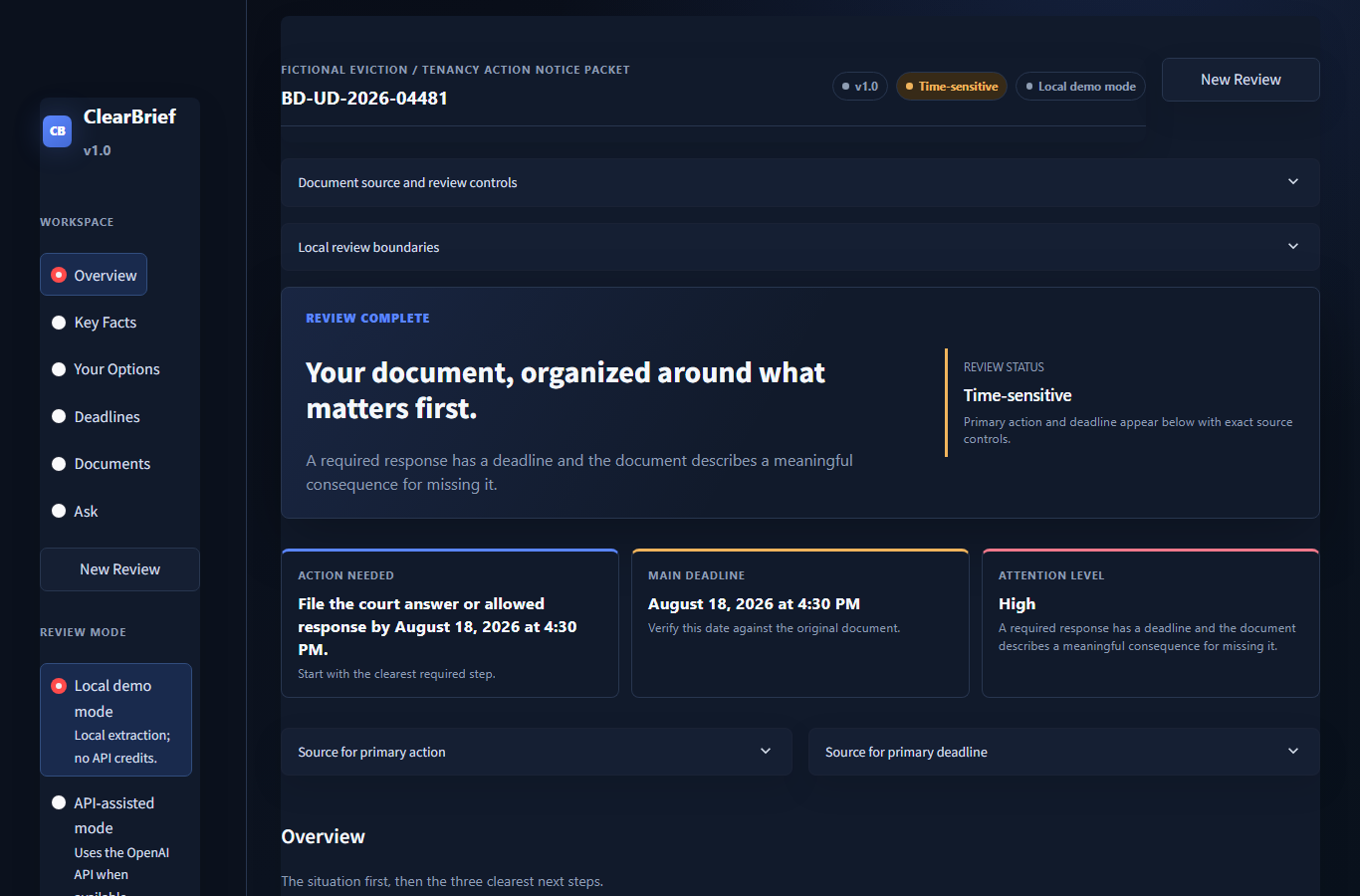
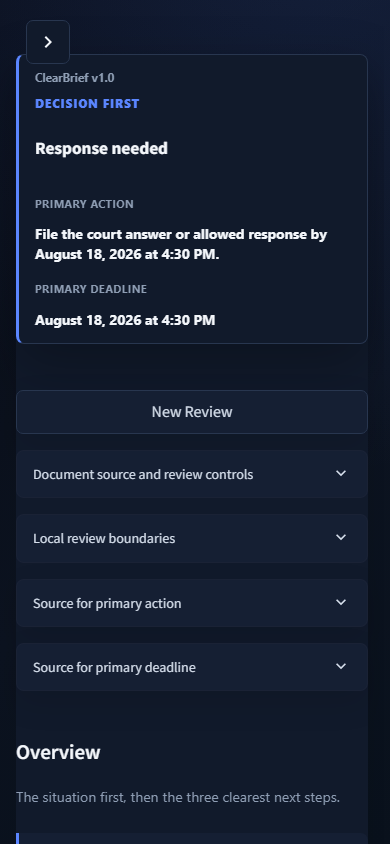
A reviewed fictional sample at desktop and phone widths.
These local-review captures use fictional content. They show ClearBrief prioritizing the required action and deadline while keeping source checks and product boundaries reachable.
Overview
Make dense notices easier to review without inventing certainty.
Administrative notices can hide required actions, deadlines, materials, contacts, and consequences across dense or unfamiliar wording. A useful review tool must make those facts easier to act on without becoming a new source of unsupported certainty.
What a reviewer does
Start with a fictional sample or bounded synthetic or appropriately redacted text, inspect the extracted actions and deadlines, then compare each primary claim with its source passage.
Required actions, deadlines, materials, contacts, consequences, and supporting passages.
No PDF extraction or OCR, and no professional-advice claim.
System
Source text becomes a reviewable action summary.
The workflow keeps extracted facts checkable and sends unsupported or conflicting critical information to manual review.
- 01Add textRun a one-click fictional sample or paste bounded synthetic or appropriately redacted English text.
- 02Review key factsReview the main meaning, response status, primary deadline, next actions, required materials, contacts, and consequence in a structured summary.
- 03Check each sectionMove through Overview, Key Facts, Your Options, Deadlines, Documents, and Ask with the same extracted facts and citations.
- 04Verify the sourceOpen exact source passages beside primary claims and compare each conclusion with the original wording.
Ground primary facts
Actions and deadlines retain exact source passages for direct comparison.
Represent statement state
Required, optional, conditional, completed, prohibited, and no-action statements remain distinct.
Fail closed
Quoted instruction-like text is isolated, and unsupported or conflicting critical facts require manual review.
Evidence
Current verification and reviewer checks.
Results are bounded to fictional English fixtures and the tested interaction matrix; they are not production-accuracy claims.
What reviewers can try
- Run the one-click fictional sample or review bounded synthetic or appropriately redacted text.
- Inspect the main meaning, response status, primary deadline, three next actions, required materials, contacts, and consequence.
- Open exact source evidence and compare claims with the original wording.
Verified evidence
- 389 passing tests in the standard suite.
- A separately passed 12-scenario public-showcase Chromium interaction matrix with zero external requests.
- 3 of 3 authored fictional samples achieved the bounded review target.
- 5 of 5 focused blind documents passed the bounded review.
- All results are fixture-bounded and do not claim arbitrary-document or production accuracy.
Limits and status
A public live prototype, with explicit limits.
The current evidence supports a bounded portfolio prototype—not arbitrary-document accuracy or professional advice.
Limits
Pasted text, TXT, and Markdown only; no PDF extraction or OCR. Local extraction uses bounded deterministic English patterns and may miss unfamiliar wording. ClearBrief is a portfolio prototype, not legal, medical, financial, benefits, or official advice, and its synthetic evaluation does not estimate arbitrary-document accuracy.
Access
Public case study at jasonabeleda.com and a no-sign-in live prototype on Streamlit Community Cloud. The public app accepts bounded fictional, synthetic, or appropriately redacted pasted text, uses deterministic local extraction only, does not offer file upload, and does not intentionally retain source text or send it to an external AI service.
Next
Try the bounded review, then inspect another project.
The live prototype accepts bounded fictional, synthetic, or appropriately redacted pasted text and runs deterministic local extraction. The guided fixture remains available as a reviewer reference.