Restaurant-led · Koreatown · one honest caveat remains visible.
$20–$38 / personHigh confidence
Responsive client-side web application · 2025–2026
Five quick choices. Three distinct routes to a good night.
Hangout OS is a responsive client-side web application that helps people choose a Los Angeles hangout without opening ten tabs or trusting a black-box recommendation. It combines curated local data, deterministic ranking, and explicit uncertainty in an inspectable five-question flow.
Restaurant-led · Koreatown · one honest caveat remains visible.
Place-only · quick effort · locality reviewed.
Event-and-food route with timing and commitment explicit.
Current deterministic portfolio-demo state · Curated, not live · Sources reviewed · Guided scenario available
Interface evidence
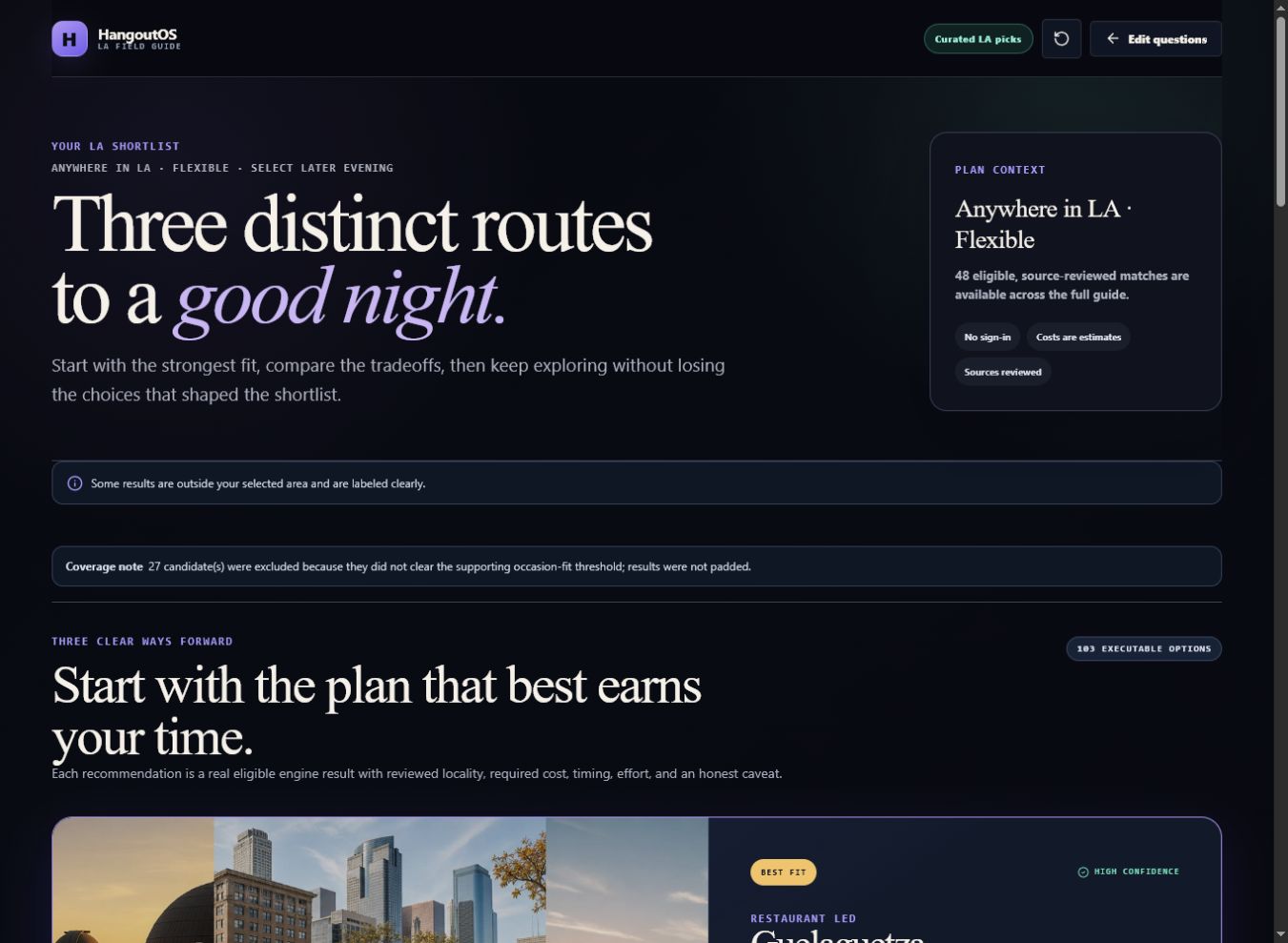
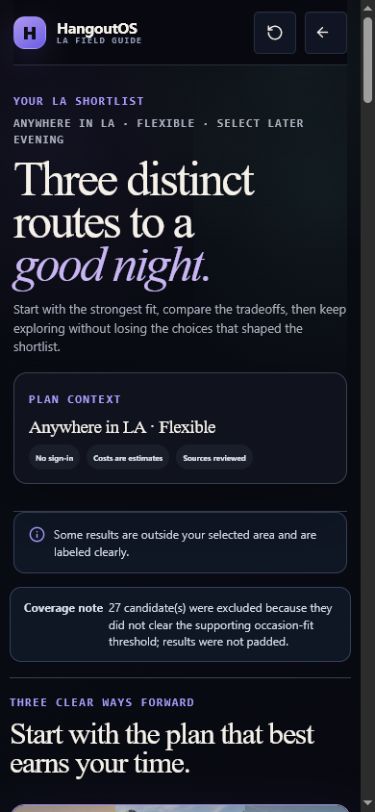
These captures come from the final local v0.10.0 review build. They show the same curated, non-live recommendation experience described in this case study.
Overview
Planning a group hangout looks simple until budget, location, timing, food, travel, and group fit collide. Most discovery products maximize choice or popularity; Hangout OS is designed to reduce decision friction without hiding tradeoffs or inventing live certainty.
Answer five selection-based questions, compare the best fit, closest or easiest option, and best value, then explore every other eligible activity, restaurant, pairing, and date-sensitive event without restarting.
Friends, couples, families, and solo planners choosing a budget-aware hangout in Los Angeles.
Five selections lead to three differentiated recommendations and an explorable set of eligible alternatives.
The catalog is intentionally curated and bounded; it does not claim complete Los Angeles coverage or live availability.
System design
Typed data and deterministic rules filter invalid options, protect required constraints, rank eligible plans, and explain the result.
Required constraints filter eligibility. Softer preferences influence ordering, but never quietly promote an invalid plan.
Budget checks use required admission, shared parking, and only a named food destination. Generic food estimates never become a promised plan total.
Results prioritize the selected area and reviewed nearby clusters. Broader-LA options remain possible only when clearly labeled.
Cards retain source-review dates, availability caveats, and official actions because curated data should never look live when it is not.
Evidence
The final local build passed 160 automated tests and 127 browser assertions across the recommendation engine, keyboard and focus behavior, reduced motion, responsive layouts, persistence, media failure states, and overflow.
These are catalog and verification signals, not adoption or conversion metrics.
Current limits
The current build distinguishes validated product behavior from public usage, complete coverage, and live information.
Public case study and guided fixture replay are live; the full application remains a local portfolio review build.
Use the public guided demo to make the core decision surface reviewable while keeping the full local application private.
Next
The guided demo makes the core shortlist hierarchy testable without presenting the curated catalog as live or publishing the full local application.